
Anti-CELSR2 [IPI-mCELSR2.52] in Surface Plasmon Resonance (SPR)
Addgene #262535
- Data Submitted By
- Aditi Kachare, Murali Anuganti, Haiying Li, Marcus Sandaire, Nicolas Petrunich, Nilisha Pokhrel Mashock, Travis Riedel and Deborah Moshinsky
- Lab Name
- Institute for Protein Innovation (IPI)
- Submission Date
- October 20, 2026
- Publication Date
- October 20, 2026 (modified November 12, 2026)
- Abstract
- Experimental results for Anti-CELSR2 [IPI-mCELSR2.52] (Addgene #262535) in SPR assay with a mouse sample.
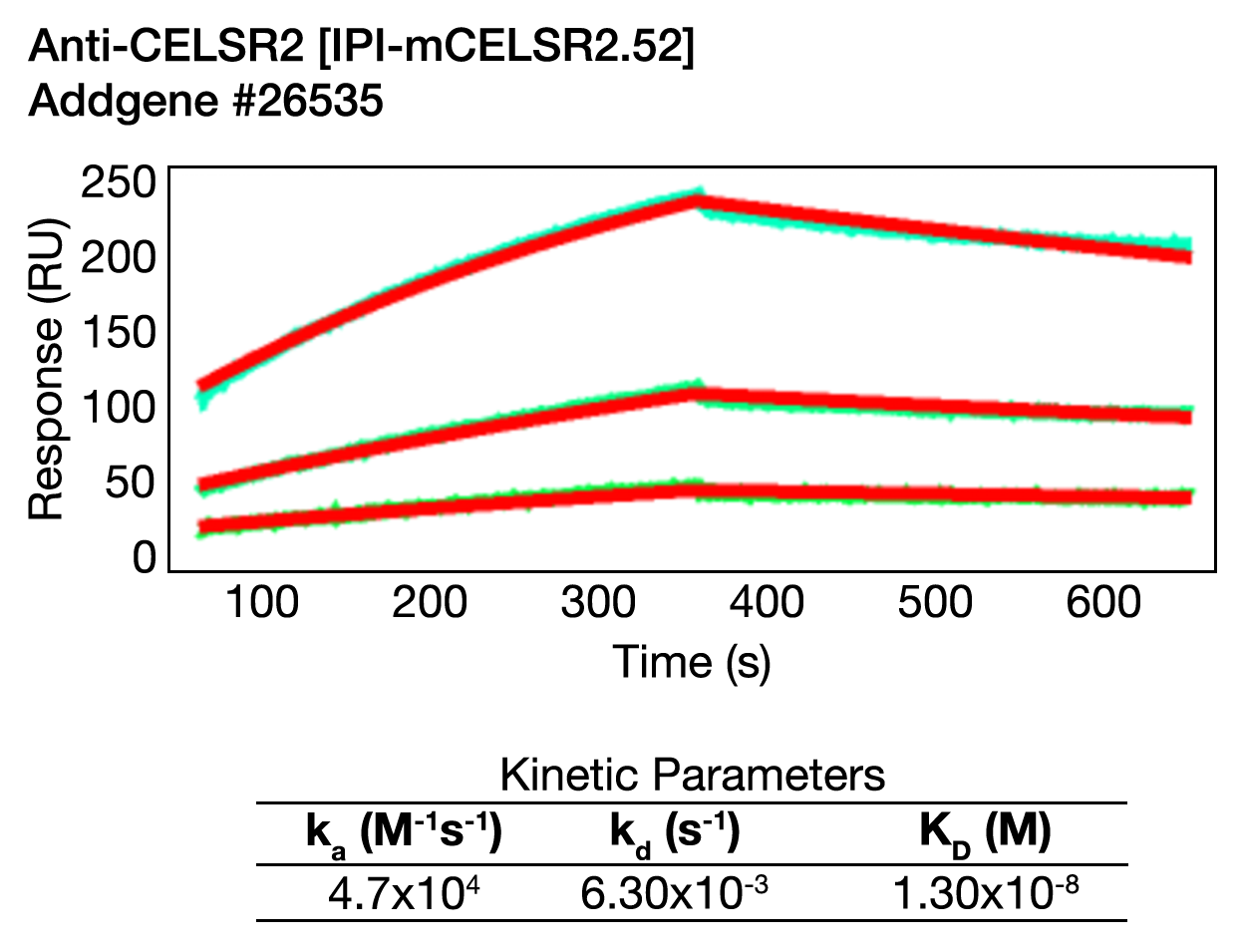
Image attribution: Institute for Protein Innovation (IPI)
This report is made available under the Creative Commons Attribution 4.0 International License.
- Antibody Used
-
Anti-CELSR2 [IPI-mCELSR2.52]
Addgene #262535
Materials & Methods
Sample
- Target Species
- Mouse
Primary Antibody
- Name
- Anti-CELSR2 [IPI-mCELSR2.52]
- Source
- Addgene
- Catalog Number
- 262535
- Host Species
- Rabbit
- Target Antigen
- CELSR2
- Concentration
- 4 µg/mL (1:250 dilution)
- Temperature
- Room Temperature
Results
- Result
- Pass (The antibody worked under these conditions)
- Describe Results
- The antibody SPR binding profile appears clean, with the model fit and residual standard deviation deemed acceptable for proceeding. Based on the ‘on’ and ‘off rates’, as well as the monovalent equilibrium dissociation constant, this antibody is categorized as a strong binder.